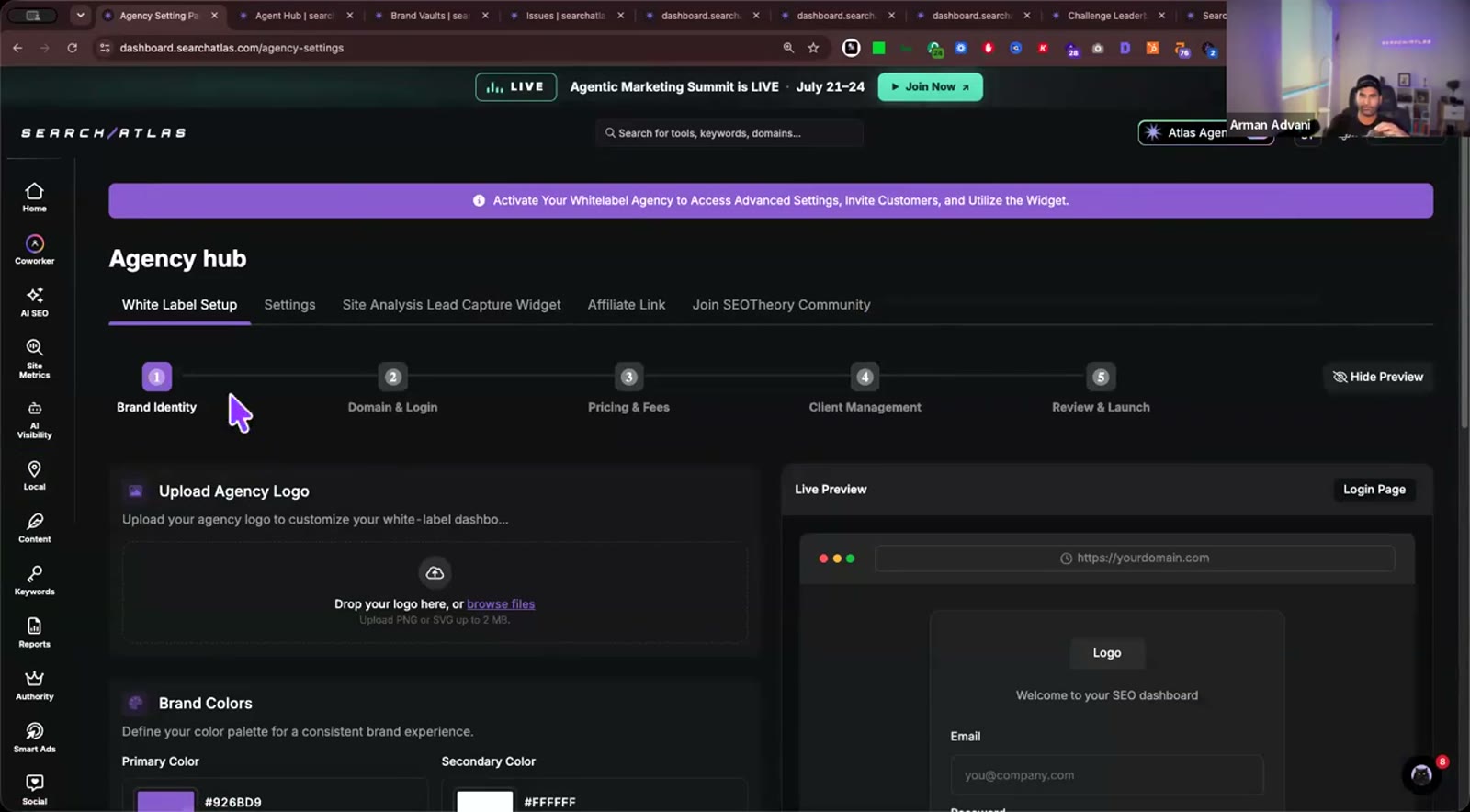
A prospecting surface we can brand.
The built-in widget covers broad site/competitor signals. The Q&A also describes custom public GBP or AI-visibility audit pages built against Search Atlas through MCP.
Internal field note / Summit 2026 / Day 01
Adam — Day One showed a platform that can find the work, present it for approval, ship it, and measure what happened. That is a materially different pitch from “one more dashboard.”
The Day One source material
The main session shows the platform. VIP After Hours shows how agencies would actually sell, connect, review, and scale it. Scrub to any timestamp to verify the context.
02:10:42 · Foundations, OTTO execution, local SEO, and the core consolidation case.
00:59:06 · Agency prospecting, GBP conversion, HighLevel/MCP, Slack Coworker, and product caveats.
Session 02 / VIP After Hours
The main session proved the platform can execute SEO work. After Hours showed how SDM could package that work into prospecting, recurring delivery, and a connected client operating system.
Standardize the service, turn audits into lead magnets, map local activity to calls and bookings, and connect Search Atlas with HighLevel inside the team’s working channel. But buy only what exists today—not the Commander/mobile roadmap.
At 00:05:54, the presenters identify non-standardized services as an early-agency mistake. Repeatable loops are the scale lever.
A targeted report, Loom, and 90-day plan become the prospecting motion—not a generic “free SEO consultation.”
GBP work should end in a booking, call, purchase, or inquiry—not a prettier profile score.
The session explicitly describes Atlas Agent bridging Search Atlas and HighLevel through MCP, operated from Slack.
Multi-project jobs, Commander, and mobile were future promises. Scores and credit burn still require independent validation.
The built-in widget covers broad site/competitor signals. The Q&A also describes custom public GBP or AI-visibility audit pages built against Search Atlas through MCP.
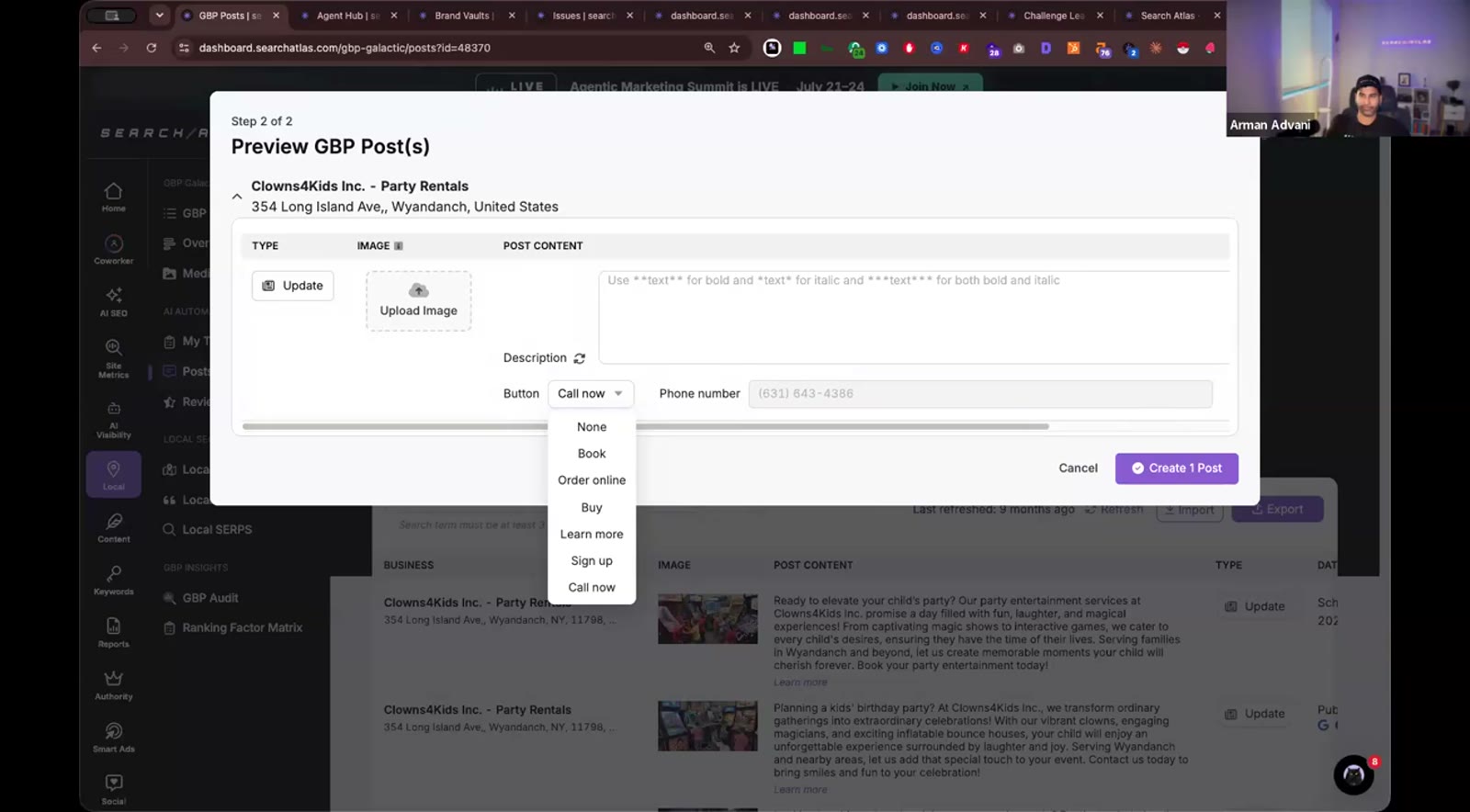
Booking links live at the profile level, while weekly posting playbooks can attach a specific CTA to each update. That is easier to sell than “we post on your GBP.”
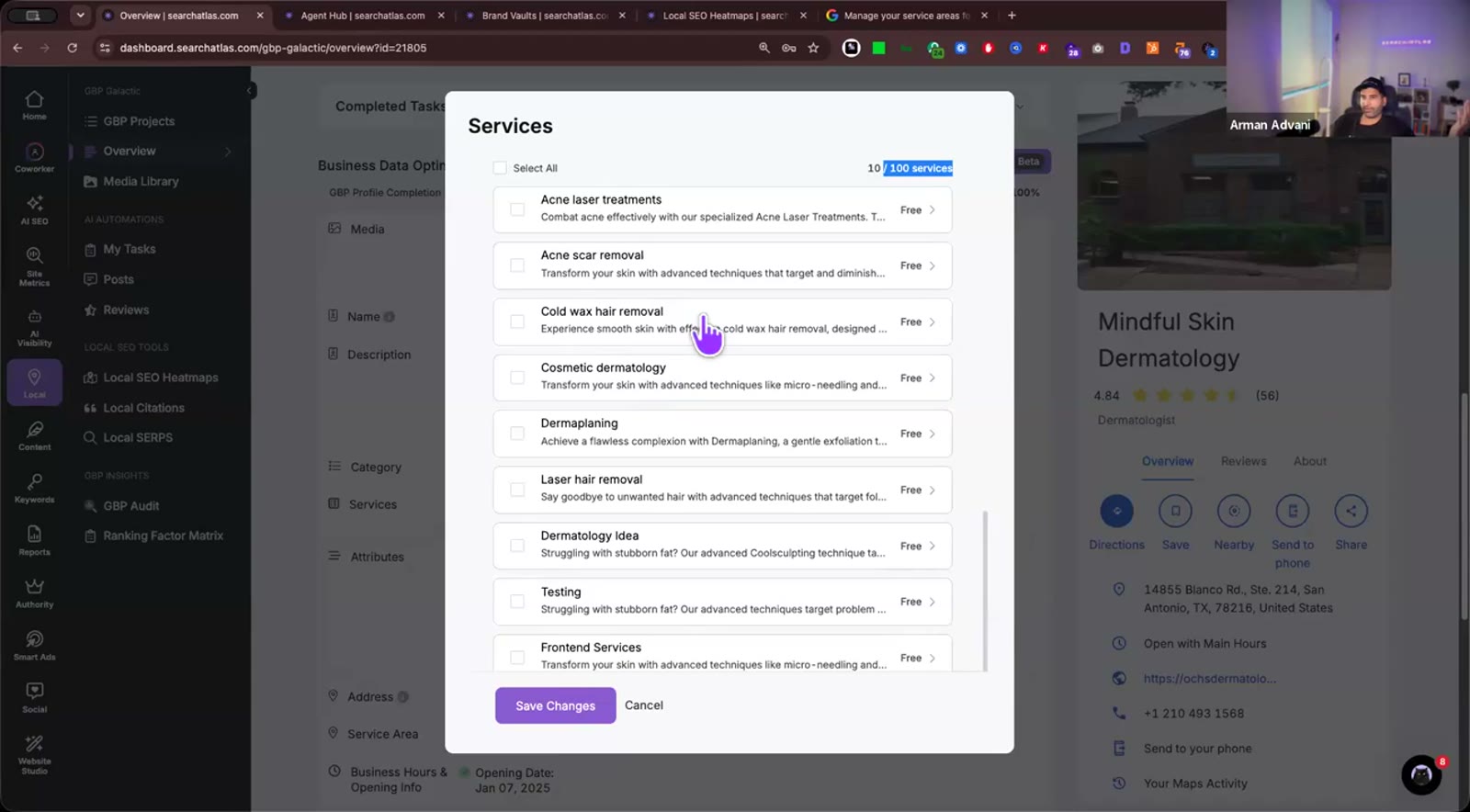
The system can suggest categories, services, and descriptions, but the operator still needs to reject offerings the client does not provide. Their recommended pattern: do the work in the agent, inspect it in the UI.
What SDM should test next
Official Day One checklist
These tasks come from the shared Summit checklist. SDM guardrails have been added where a direct deployment or external connection deserves review.
Summit resources
Documentation, community, and event resources.
These dashboard links require a Search Atlas login.
TL;DR for Adam
Semrush and other tools are excellent at showing us what is wrong. Day One’s strongest proof was the move from audit → recommendation → approval → live deployment → re-check.
Technical SEO, rank tracking, keyword research, local heatmaps, GBP audits, AI visibility, publishing, and reporting now live in the same product family. That creates real overlap with tools we already fund.
Standardized playbooks, fewer handoffs, shareable local audits, and faster implementation can improve margin and capacity—even if the top agency plan is not the cheapest line item.
Vendor demos are not production proof. We need to verify data quality, CMS behavior, review/citation depth, reporting, rollback, and how much human QA the output actually requires.
What Day One actually demonstrated
The screenshots are pulled from the recording. Time claims and performance claims remain vendor-reported until SDM reproduces them.
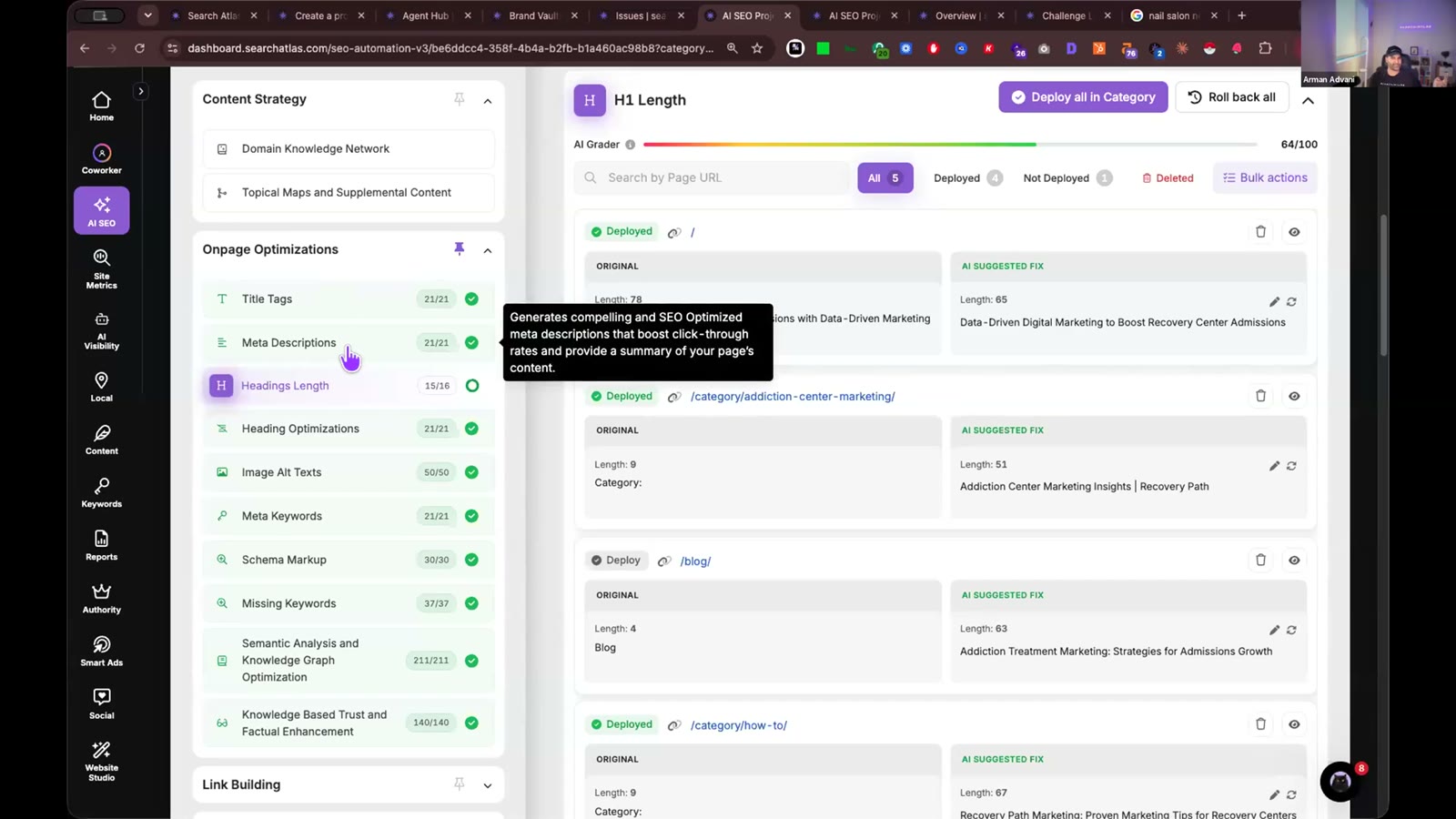
The demo starts with the familiar auditor experience: titles, descriptions, headings, internal links, schema, and other issues. OTTO then proposes replacements, lets the user preview them, deploys approved changes, and offers a fresh audit or scheduled refresh.
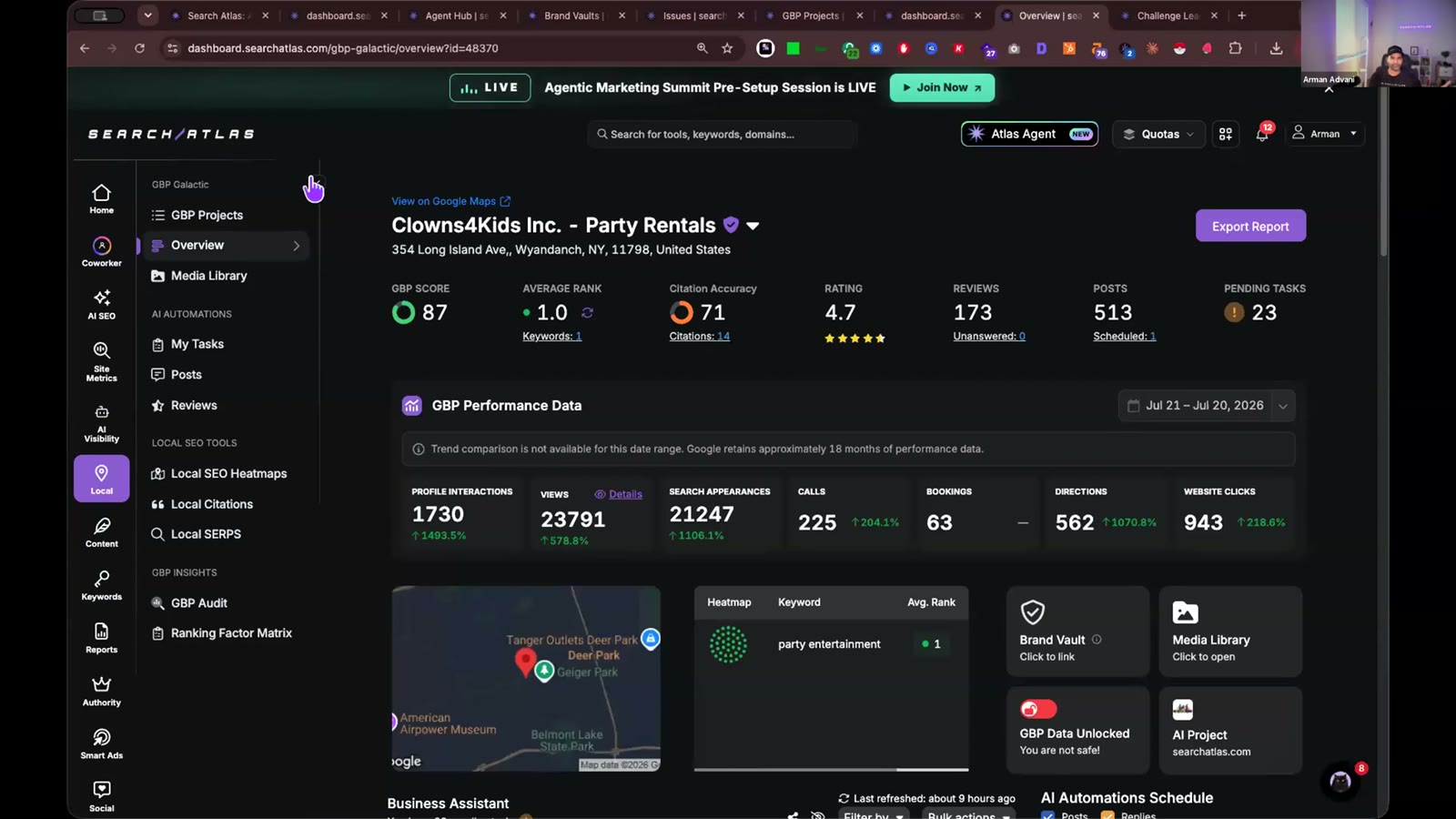
The local module combines GBP health, map rank, citations, reviews, posting, calls, bookings, and geo-grid visibility. The same audit can be exported or shared with a prospect.
Traditional automation repeats. Their “golden loop” watches the result and chooses what comes next. For SDM, that could mean recurring technical hygiene, local profile maintenance, ranking-drop checks, and client reporting—each with an approval gate until trust is earned.
“Go from audit to review to execution in as few clicks as possible and buy back your time.” Day One, 01:29:29
Why this matters to our agency
01 / Sales
Exportable GBP audits and geo-grid maps give prospects a visual “here is where you lose” story instead of a vague SEO pitch.
See 01:54:3802 / Margin
If the deployment quality holds, strategists spend less time translating auditor tickets into developer tasks and checking whether they shipped.
See 01:18:1303 / Scale
Playbooks and scheduled jobs can turn our best technical, local, and reporting routines into repeatable delivery across more accounts.
See 01:39:2904 / Retention
Clients should see what changed, why it changed, and what moved afterward—not only another monthly rank screenshot.
See 01:28:10What could it replace?
The right question is not “does Search Atlas have a feature with the same name?” It is “can it match the data, workflow depth, reliability, and client output we actually use?”
| Current spend area | Search Atlas overlap | Consolidation confidence | What must pass the pilot |
|---|---|---|---|
| SemrushResearch, audits, tracking, competitive data, AI visibility | Site audit, keywords, gaps, rank tracking, competitors, backlinks, reporting, LLM visibility—plus OTTO deployment. | Strong overlap | Keyword/backlink database parity, historical continuity, limits, export/API needs, and report quality. |
| BrightLocalLocal audits, grids, listings, reputation | GBP audits, local heatmaps, ranking factors, citations, review signals, posts, calls, and bookings. | Strong, with gaps to test | Citation building, listing sync, review workflows, multi-location limits, and historical reports. |
| Merchynt?Assuming “Merchant” means Merchynt / GBP automation | GBP optimization playbooks, scheduled maintenance, local audits, posts, review signals, and citations. | Likely overlap | Confirm the actual vendor; then test review acquisition/response, citation deliverables, and per-location economics. |
| Other point toolsReporting, content optimization, schema, AI tracking | White-label reporting, publishing, content workflows, schema/LLMs.txt generation, and AI visibility monitoring. | Inventory first | Pull the last 90 days of software charges and map every paid workflow before claiming savings. |
Important: Keep every current tool active during the pilot. We only cancel after output parity and data continuity are proven.
The honest cost story
Using current public starting prices, one Semrush + BrightLocal + Merchynt scenario begins around $447/month before extra locations, seats, citations, add-ons, or the labor required to move work between them.
Search Atlas currently lists Pro at $399/month and Agency at $999/month. Day One mentioned a 30% summit discount, implying roughly $279 or $699 if eligible. Verify the offer, included projects, GBP limits, and quotas before purchase.
The recommendation
Not a company-wide migration. Not a vendor-love decision. A controlled side-by-side test designed to answer whether Search Atlas improves SDM’s margin and client delivery.
Week 01
Pull 90 days of software charges. Choose three client types. Connect GSC, GA4, GBP, and the CMS. Document the current baseline.
Week 02
Run the audit and OTTO playbook. Review every proposed change. Deploy a limited batch, test the live site, and confirm rollback.
Week 03
Build a GBP audit and geo-grid report. Compare with BrightLocal. Put the output in front of Adam as if it were a real prospect call.
Week 04
Compare data, outputs, hours, and plan limits. Decide what to keep, cancel, or defer—one workflow at a time.
Pass / fail scorecard
Bottom line
Day One is enough to justify a pilot. It is not enough to justify deleting the current stack. If Search Atlas passes the scorecard, we consolidate with confidence—and turn the same workflow into a stronger sales story for clients.
Return to the recordingDay One transcripts were generated locally from the 2h 10m main session and 59m VIP After Hours recording. Timestamps may vary by a few seconds. Product claims, time-saved figures, roadmap dates, case-study counts, integrations, and summit discounts are vendor-reported until independently reproduced.
“Merchant” was interpreted as Merchynt, the GBP/local SEO platform. If that is a different vendor, update the comparison before using it for a purchase decision.